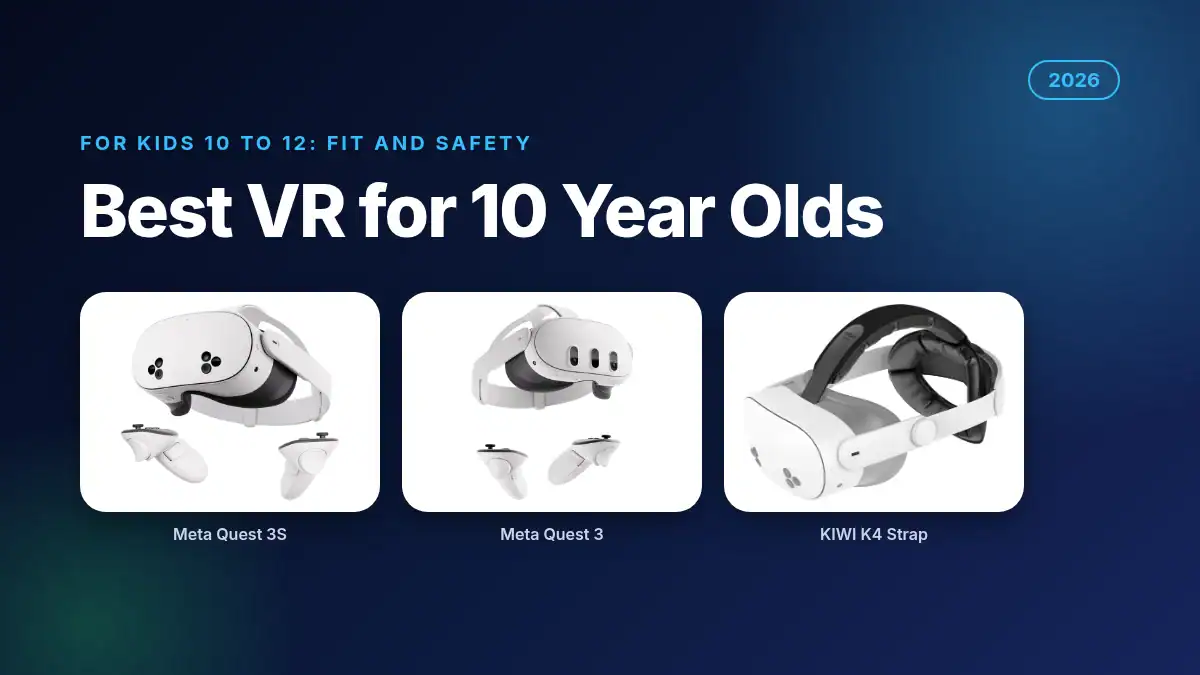
Best VR Headset for 10 Year Old Kids: Fit and Safety (2026)
The best VR headset for 10 year old kids has to do three things: fit a smaller face and head, run safely without a PC or cables, and give parents real controls over games, chat and screen time. This guide compares the VR headsets and add-ons on Amazon that fit those needs for kids aged 10 to 12.
Last updated: October 30, 2026. By Chris, editor at Toy Hobbyist, who compares toys, tech and gifts for kids. We compared VR headsets using Meta and Sony age rules, published lens and weight specs, parent control features and Amazon buyer feedback. Prices, stock and ratings were checked on Amazon (US) on October 30, 2026.
Quick answer: The Meta Quest 3S 128GB is the best VR headset for most 10 year olds. It is standalone, works with Meta’s parent-managed accounts for ages 10 to 12, has a 58 mm lens setting for smaller eyes and costs $349.00, rated 4.6 out of 5 by 6,774 Amazon buyers. Get the Quest 3 if your child’s eyes sit closer together.
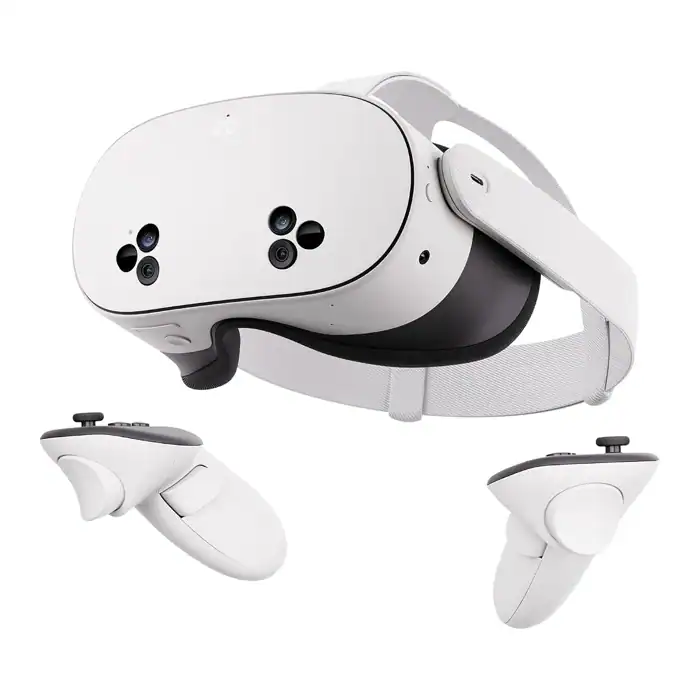
Meta Quest 3S 128GB
A standalone VR headset with no PC or cables, Snapdragon XR2 Gen 2 and about 2.5 hours of battery. Works with Meta parent-managed accounts for ages 10 to 12, with app approval and time limits, and has a 58 mm lens setting for smaller eyes.
| Best For | Kids aged 10 to 12, first headset |
| Price | $349.00 (Oct 30, 2026) |
| Discount | Sold and shipped by Amazon.com |
| Promotion | Rated 4.6 by 6,774 buyers |
What is the best VR headset for a 10 year old in 2026?
The best VR headset for a 10 year old in 2026 is the Meta Quest 3S 128GB ($349.00), because it meets Meta’s minimum age of 10 and supports parent-managed accounts. The Quest 3 512GB is the best fit for kids with narrow eyes, and the Renewed Premium Quest 3S is the budget pick. Add a comfort strap and a case.
| Pick | Best for | Lenses and eye spacing | Weight (published spec) | Battery (average) | Price (Oct 30, 2026) | Amazon rating | Our score |
|---|---|---|---|---|---|---|---|
| Meta Quest 3S 128GB | Best overall for ages 10 to 12 | Fresnel, 3 settings: 58, 63 and 68 mm | 514 g | About 2.5 hours | $349.00 | 4.6 (6,774 ratings) | 4.6 / 5 |
| Meta Quest 3 512GB | Best fit for narrow eyes, best picture | Pancake, dial from 53 to 75 mm | 515 g | About 2.2 hours | $599.99 | 4.4 (6,145 ratings) | 4.5 / 5 |
| Meta Quest 3S 128GB Renewed Premium | Budget, same headset | Same as Quest 3S | 514 g | About 2.5 hours | $319.99 | 4.5 (1,029 ratings) | 4.3 / 5 |
| KIWI design K4 Head Strap | Comfort add-on for Quest 3 and 3S | Not applicable | 233 g | No battery | $33.99 | 4.8 (3,826 ratings) | 4.4 / 5 |
| bibuks Hard Carrying Case | Protecting the lenses between sessions | Not applicable | Not listed | Not applicable | $27.99 | 4.6 (345 ratings) | 4.2 / 5 |
Is a 10 year old old enough for VR?
Yes, if the headset fits and a parent sets it up. Meta’s minimum age for Quest accounts is 10, and children aged 10 to 12 need a parent-managed account. Meta still warns that VR is not a toy and is not recommended for smaller children or anyone the headset cannot be adjusted to fit properly.
Meta’s own safety guide for the Quest 3S says children’s use should always be supervised by an adult, that adults should help with fit, the play space, content choice and breaks, and that younger children should take more frequent and longer breaks. It also suggests a maximum first session of 30 minutes followed by a 15 minute break when someone starts using a new headset.
Sony is stricter. PlayStation VR2 is not for children under 12, so we left it out of this guide even though it is a great headset for teens with a PS5.
Which VR headset fits a child’s eyes best?
The Meta Quest 3 fits more kids, because its lenses dial anywhere from 53 to 75 mm apart. The Quest 3S has three set positions at 58, 63 and 68 mm, and Meta recommends the 58 mm setting for anyone with an eye spacing of 61 mm or less. Kids below about 58 mm fit the Quest 3 better.
Eye spacing, called interpupillary distance or IPD, matters more for kids than for adults. Meta’s safety guide warns that a child’s IPD may be smaller than the headset’s lens spacing, and that a poor fit raises the risk of eye strain, blurry vision, headaches or nausea. Neil Dodgson’s widely cited 2004 review of IPD data puts the adult average at about 63 mm, with children as young as five down to about 40 mm. A study of Nigerian students aged 3 to 21 found an average distance IPD of about 59.9 mm in boys and 58.9 mm in girls aged 8 to 12.
Kid VR fit check: measure your child’s IPD with a ruler in a mirror or a free PD app, then find their row. Headset ranges come from Meta’s published lens specs, and the 61 mm cut-off is Meta’s own advice for the Quest 3S.
| Child’s IPD | Quest 3S lens setting | Quest 3 lens setting | What to buy |
|---|---|---|---|
| Under 53 mm | 58 mm, wider than their eyes | Below the 53 mm minimum | Wait a year or two, the fit is likely to blur |
| 53 to 57 mm | 58 mm, slightly wide | Dial to their exact IPD | Quest 3 512GB |
| 58 to 61 mm | 58 mm, a good match | Dial to their exact IPD | Quest 3S 128GB |
| 61 to 66 mm | 63 mm | Dial to their exact IPD | Quest 3S 128GB |
| Over 66 mm | 68 mm | Dial to their exact IPD | Quest 3S 128GB |
If the picture is still blurry after you adjust the lenses and the strap, stop the session. Meta’s guide says to check image clarity after every lens change and to keep the headset weight balanced between the forehead and cheeks.
How did we choose these VR headsets?
We started with every standalone VR headset sold on Amazon (US), then kept only headsets whose maker allows use at age 10 and offers parent controls, which today means Meta Quest. We compared lens fit, weight, battery, storage and price, then added the two accessories parents most often buy to make a headset fit and last.
Our scores are editorial ratings out of 5. They weigh age rules and fit first, then parent controls, comfort and battery, then buyer feedback and value for money. We did not include cheap phone VR viewers, which have no parent controls and no lens fit adjustment, or PC headsets, which need a gaming PC and are built for adults.
Which VR headset should you buy for your 10 year old?
Buy the Meta Quest 3S 128GB for most 10 to 12 year olds, since it does everything a child needs for $349.00. Buy the Quest 3 512GB if your child’s eyes measure under 58 mm or you want the sharpest picture. Pick the Renewed Premium Quest 3S to save money, and add the K4 strap for comfort.
1. Meta Quest 3S 128GB (Best Overall)
The Meta Quest 3S is the headset most families should buy for a 10 year old. It is fully standalone, so there is no PC, console or cable to trip over, and it runs on the same Snapdragon XR2 Gen 2 chip and 8 GB of RAM as the more expensive Quest 3. Meta lists about 2.5 hours of average battery life, which is longer than the Quest 3.
The key point for parents is that it works with Meta’s parent-managed accounts for ages 10 to 12, so you approve apps, set daily time limits and control who your child can talk to from the Meta Horizon app. The lenses slide between 58, 63 and 68 mm, and the 58 mm setting suits kids with an IPD up to about 61 mm. This version is sold and shipped by Amazon.com for $349.00 and comes with a Gorilla Tag Cardboard Monkenaut bundle, rated 4.6 out of 5 by 6,774 buyers.
The soft cons are the lenses and the strap. The Fresnel lenses are less sharp than the Quest 3’s, and some buyers report blurry images, which often comes down to fit. Buyers also say the stock strap gets uncomfortable on long sessions and that the battery runs out after a couple of hours. Skip the Batman: Arkham Shadow bundle for a 10 year old, as that game is rated M for Mature.
Pros:
- Meets Meta’s minimum age of 10, with parent-managed accounts
- Standalone, no PC or cables
- About 2.5 hours average battery, the longest here
- $349.00, sold by Amazon.com, 4.6 out of 5 from 6,774 ratings
Cons:
- Three fixed lens settings, the narrowest is 58 mm
- Fresnel lenses are less sharp than the Quest 3
- Stock strap can feel uncomfortable on long sessions
2. Meta Quest 3 512GB (Best Fit for Narrow Eyes)
The Meta Quest 3 is the better headset for kids whose eyes sit close together. Its pancake lenses dial smoothly from 53 to 75 mm, so you can set the exact spacing for a child with a 54 or 56 mm IPD instead of settling for the closest preset. The pancake lenses are also sharper edge to edge, and Meta markets a 4K+ Infinite Display with nearly 30% more resolution.
It uses the same chip and parent controls as the Quest 3S, adds full-color passthrough from two RGB cameras, and has 512 GB of storage, which is plenty for a child who likes to download games. It is sold and shipped by Amazon.com for $599.99, rated 4.4 out of 5 by 6,145 buyers, and its Amazon listing gives an age range of 10 and up.
It costs $250 more than the Quest 3S, and battery life is shorter at about 2.2 hours. Some buyers say the battery drains quickly in demanding games and that the controllers can be unreliable, while others say it runs flawlessly.
Pros:
- Lenses dial from 53 to 75 mm, the best fit for narrow eyes
- Sharper pancake lenses and full-color passthrough
- 512 GB of storage
- Sold by Amazon.com, 4.4 out of 5 from 6,145 ratings
Cons:
- $599.99 is a lot for a child’s first headset
- Shorter battery life than the Quest 3S
- Mixed controller feedback
3. Meta Quest 3S 128GB Renewed Premium (Best Budget)
The Renewed Premium Quest 3S is the same headset as our top pick, refurbished and sold by Amazon.com for $319.99. That saves about $29 on the new price, and it keeps the same parent controls, the same 58 mm lens setting and the same standalone setup. It is rated 4.5 out of 5 by 1,029 buyers, who often call it well worth the money and easy to set up.
Amazon Renewed Premium products come with a minimum 1-year Amazon Renewed Guarantee, so check that the listing still shows it before you buy. Buyers who use it as a family headset say kids love it, and one parent notes their son quickly got hooked on the games, which is a good reason to set time limits on day one.
The saving is small, so a new Quest 3S with its bundle is often the better value. Image quality, comfort and battery life get the same mixed feedback as the new headset.
Pros:
- Same Quest 3S headset for less
- Sold and shipped by Amazon.com
- 4.5 out of 5 from 1,029 ratings
Cons:
- Only about $29 cheaper than new
- No bundled game
- Mixed comfort and battery feedback
4. KIWI design K4 Head Strap (Best Comfort Add-On)
The KIWI design K4 replaces the soft stock strap on a Quest 3 or 3S with a rigid strap and an enlarged rear headrest. It weighs 233 g, uses memory foam and soft PU leather padding, and a dial tightens it quickly, which helps on a smaller head. KIWI design says the balanced design takes pressure off the face.
It is the highest rated pick in this guide, at 4.8 out of 5 from 3,826 buyers, who say it is easy to put on and take off, holds the headset securely during games and is far better than the stock strap. It is sold by KIWI design Direct US and shipped by Amazon for $33.99.
It has no built-in battery, so it will not extend play time, and it adds weight to the headset. For kids, that is a fair trade, since shorter sessions are the goal anyway.
Pros:
- Spreads the headset’s weight off the face
- Quick dial adjustment for smaller heads
- 4.8 out of 5 from 3,826 ratings
Cons:
- No battery, so no extra play time
- Adds 233 g to the headset
5. bibuks Hard Carrying Case (Best for Protecting the Lenses)
A case is the cheapest way to make a VR headset last in a house with kids. Meta warns that sunlight can damage the lenses and that rough handling can crack them, so the headset should not sit on a windowsill or the floor. The bibuks case fits a Quest 3 or 3S with its controllers, with an EVA hard shell, a felt lining and a mesh pocket for the charger and cables.
It comes in seven colors, has a shoulder strap and a top handle, and is rated 4.6 out of 5 by 345 buyers, who like how sturdy it is and the covered controller compartments. It is sold by Woot and shipped by Amazon for $27.99.
Some buyers say it is too small once a bulky aftermarket strap is fitted, so check the fit if you add the K4 or a battery strap.
Pros:
- Hard shell protects lenses from sun and drops
- Holds the headset, controllers and charger
- $27.99, ships from Amazon
Cons:
- Can be tight with large aftermarket straps
- Sold by Woot rather than Amazon.com
How do you set up a Meta Quest safely for a 10 year old?
Create your own Meta account first, then set up a parent-managed account for your child in the Meta Horizon app. From there you can approve app downloads, set daily time limits and manage who they talk to. Then fit the lenses to their eyes, clear a play space and start with short sessions.
Parent setup checklist for a 10 year old:
- Make the child’s account parent-managed (required for ages 10 to 12)
- Turn on app approval so every download needs your OK
- Set a daily time limit, and start with sessions of 30 minutes or less
- Set the lens spacing to their IPD and check the picture is sharp
- Draw the safety boundary for them in a room with no stairs, glass or ceiling fans
- Pick games rated E or E10+ and Comfortable on the Meta Horizon Store
Our guide to how much screen time is right for kids covers daily limits by age, which you can then set in the Meta Horizon app.
Is VR better than a game console for a 10 year old?
VR is more active and more immersive, but a console is easier to share and to supervise, because everyone can see the screen. Many families start with a console such as a Nintendo Switch and add a Quest later as a second, time-limited device for active games, fitness and creative apps.
If you are still choosing between systems, our best gaming systems for kids guide compares consoles by age. For other tech gifts for this age, see our best drone for kids with camera and screen picks and our best RC car for 10 year old guide.
FAQ
What is the best VR headset for a 10 year old?
The Meta Quest 3S 128GB is the best VR headset for most 10 year olds. It meets Meta’s minimum age of 10, supports parent-managed accounts, has a 58 mm lens setting and costs $349.00, rated 4.6 out of 5 by 6,774 Amazon buyers. The Quest 3 fits children with narrower eyes better.
Can a 10 year old use a Meta Quest?
Yes. Meta’s minimum age for Quest accounts is 10 in most countries, and children aged 10 to 12 must use a parent-managed account set up by a parent. Meta also says children’s use should always be supervised, with help on fit, content, the play space and breaks.
Is the Quest 3 or Quest 3S better for kids?
The Quest 3S is better for most kids because it costs $250 less and has longer battery life. The Quest 3 is better for children with an IPD under about 58 mm, since its lenses dial down to 53 mm, and for families who want the sharpest picture.
How long should a 10 year old play VR?
Meta suggests a first session of no more than 30 minutes followed by a 15 minute break, and says younger children should take more frequent, longer breaks. Set a daily limit in the Meta Horizon app and stop any session if your child reports eye strain, headaches, dizziness or nausea.
Is PlayStation VR2 okay for a 10 year old?
No. Sony says PlayStation VR2 is not for children under 12, so it is not a good choice for a 10 year old. It also needs a PS5. For a child aged 10 or 11, a Meta Quest 3S or Quest 3 with a parent-managed account is the better option.