Power Wheels Not Working? How to Fix a Ride-On Car That Won’t Move (2026)
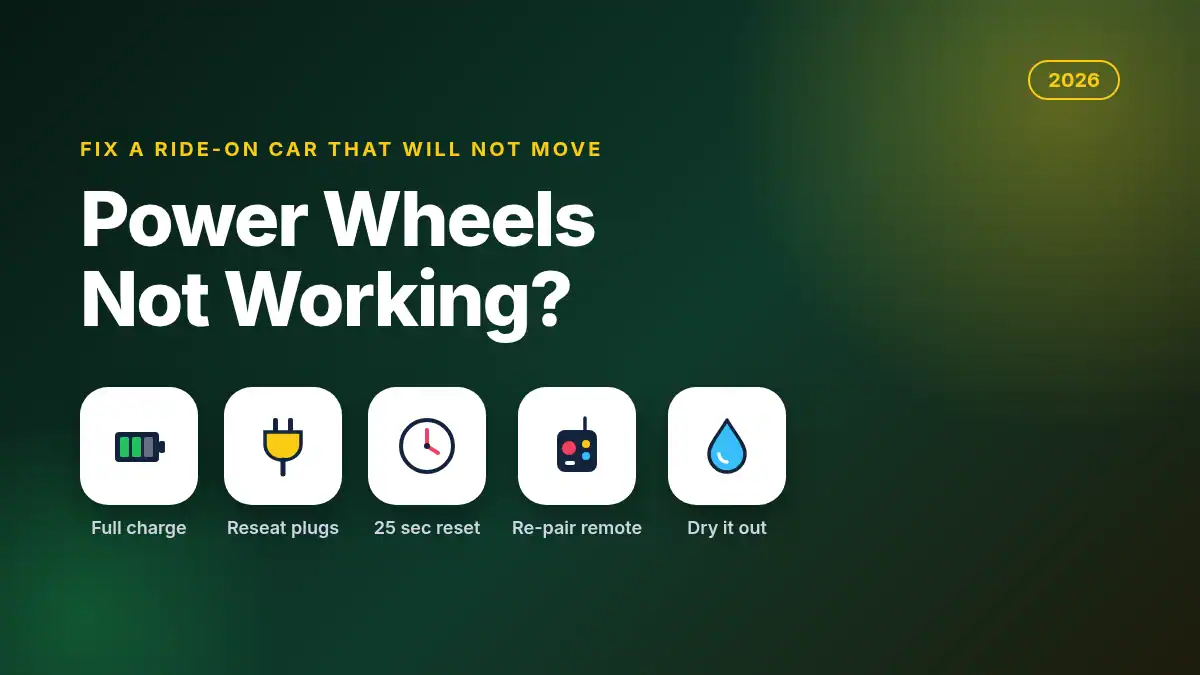
Short answer: Power Wheels not working? The cause is almost always the battery or a connection, not the motor. Charge the battery for a full 14 to 18 hours, push every plug together until it clicks, wait 25 seconds if the car cut out mid-ride, and check the shifter, speed lock-out and remote mode switch. Only after those fail should you suspect the pedal switch, the motors or a dead battery. The same steps work for most 6V, 12V and 24V kids ride-on cars.
Last updated: October 30, 2026. By Chris, who runs Toy Hobbyist and writes about kids toys and ride-ons. Charging times, the thermal fuse reset and battery life figures come from the official Power Wheels owner’s manual and Mattel’s customer service FAQ, both linked below. Tips for generic ride-ons come from owner and repair forum reports.
It is a classic scene: a toddler in the driver’s seat, horn honking, lights flashing, music playing, and the car going absolutely nowhere. Or it worked fine for twenty minutes and then quit in the middle of the lawn, which is always the farthest point from the garage. Before you start pricing a new one, run through the checks below. Most fixes cost nothing but time.
Why Are My Power Wheels Not Working?
The most common reasons are an undercharged or worn-out battery, a loose battery or motor plug, a thermal fuse that tripped from overloading, a shifter or speed lock-out in the wrong position, and, on cars with a parent remote, the car being stuck in remote mode. Water and sand in the switches and worn motors come later.
The official Power Wheels owner’s manual lists the same short set of causes for “vehicle does not run”: undercharged battery, charger not working, tripped thermal fuse, loose wires or connectors, a dead battery, electrical switch damage and motor damage. In that order, which is helpful, because it is roughly the order of how cheap they are to fix.
What Does Each Ride-On Car Problem Usually Mean?
The symptom narrows it down fast. Lights and music but no movement points to a weak battery, a loose motor plug or the pedal switch. Stopping mid-ride points to a tripped fuse or a loose connector. Short run time points to charging habits or an old battery. One spinning wheel can be normal.
Here is the Ride-On Car No-Go Checklist, the citable part of this guide. Start at the top of your symptom row and work right.
| Symptom | Check first | Then check | Last resort |
|---|---|---|---|
| Completely dead, no lights or sound | Battery plugged in and fully charged | Inline fuse near the battery (many generic cars), power button | Battery or charger test at a service center |
| Lights and music work, car will not move | Full charge (a weak battery can run lights but not motors) | Motor harness plug, shifter position, remote or manual mode switch | Pedal switch, then motors |
| Ran fine, then suddenly stopped | Foot off the pedal, wait 25 seconds | Weight, hills, towing, wheels jammed against something | Fuse that keeps tripping, see service center |
| Runs, but slow or sluggish | Charge for at least 14 hours | Overloading, thick grass, uphill | Battery past its 1 to 3 year life |
| Short run time | Charging after every use | Overcharging past 30 hours | Replace the battery |
| Will not go into high speed | High speed lock-out screw | Shifter fully seated | Shifter switch |
| Only one rear wheel spins when lifted | Often normal in low speed | Slow the spinning wheel by hand, the other should turn | Drive system repair |
| Remote does nothing | Remote batteries and pairing | Car switched to remote mode | Receiver box in the car |
How Long Should You Charge a Power Wheels Battery?
Charge a new Power Wheels battery for at least 18 hours before the first ride, then for at least 14 hours after every use, and never longer than 30 hours. Mattel also says to charge right after use, because a battery left sitting drained gets damaged. A fully charged battery can sit for two to three months.
Those numbers come straight from Mattel’s Power Wheels battery charging FAQ and the Power Wheels 12V owner’s manual. The first charge is the one people skip. The box arrives on a birthday, the battery has some charge from the factory, and the car runs for ten minutes before dying. That is not a broken car. That is a battery that never got its full first charge.
Generic ride-on brands often give shorter charge times in their own manuals, so check yours. The general rule still applies: charge after every ride, do not run it completely flat, and do not leave it on the charger for days.
Why Do Power Wheels Have Lights and Sound but Not Move?
Lights, horn and music use very little power, while the motors need a lot. A battery that is nearly flat or aging can run the sound box and still be too weak to turn the wheels. The other usual causes are a loose motor harness plug, a gear shifter caught between positions or a car left in remote mode.
- Charge it fully first. Do not judge the battery by the lights. Give it a proper 14 hour charge before you go any further.
- Reseat the plugs. Unplug the battery connector and the motor harness connector, look for bent or burnt pins, then push them back together firmly.
- Check the shifter. Move it fully into forward low, then try again. A shifter halfway between gears often does nothing.
- Check the mode switch. Many ride-ons with a parent remote have a switch or button that sets remote or manual driving. In remote mode the pedal may do nothing.
- Listen at the motors. With the rear wheels lifted, press the pedal. A click with no hum points to the pedal or wiring. A hum with no movement points to the gearbox.
If you own a multimeter, a rested 12V lead-acid battery that reads well under 12 volts after a full charge is worn out. If you do not own one, the manual’s advice is simple: a Power Wheels authorized service center can test the battery and the charger for you.
Why Did the Ride-On Car Suddenly Stop Mid-Ride?
Usually the built-in thermal fuse tripped. It is a self-resetting safety cutoff that shuts the car down when it is overloaded or the driving is too tough. Take your foot off the pedal, wait about 25 seconds and try again. If it keeps happening on flat ground, check the connectors and get the battery tested.
The owner’s manual lists what trips it: going over the 130 lb (59 kg) weight limit on the 12V model in that manual, towing anything, driving up hills, and running into fixed objects so the wheels stop while power is still flowing. Other models have other limits, so check the sticker or manual for yours. In plain terms: a sibling riding on the back, a wagon tied to the bumper and a fence the car keeps pushing against are all fuse trippers.
The other cause of a sudden stop is a plug that wiggles loose over bumps. If the car cuts out on rough ground and comes back when you jiggle the battery, the connector is your culprit.
How Do You Fix a Ride-On Car Remote That Is Not Working?
Start with fresh batteries in the remote, then re-pair it. On many generic 12V ride-ons you pair by holding the pairing or match button on the remote while switching the car on, until a light stops blinking. Also check that the car is in remote mode and that the antenna wire on the receiver is not pinched.
Pairing steps vary by brand, and Power Wheels models with a parent remote follow their own manual, so look for the “pairing” or “code matching” page in yours. Owners on repair forums report that many remotes come unpaired after a battery swap, which is why it is worth trying first. If the remote still does nothing, the receiver box under the seat may be the problem, and most brands sell replacements as a part.
How Long Does a Power Wheels Battery Last?
According to the Power Wheels manual, average battery life is 1 to 3 years, depending on how much the car is used and how the battery is treated. Run time per charge for the 12V model is about 1 to 3 hours. Leaving a battery drained, storing it hot or cold, and overcharging all shorten its life.
The battery care rules from the manual are worth taping inside the garage:
- Charge after every use, however short the ride.
- Do not let the battery run down completely before charging.
- Charge it before storing the car, and at least once a month even if nobody rides it.
- Do not store the battery above 75 degrees F or below minus 10 degrees F.
- Replace a worn battery only with the battery type made for your car. The manual specifically says not to substitute parts.
Winter is where most batteries die. The car gets parked in October, nobody charges it, and in spring the battery is ruined. A monthly calendar reminder costs nothing and saves a replacement battery.
Can Rain or Water Break a Power Wheels Car?
Yes. The manual warns that water or moisture in the motors or electrical switches can cause corrosion and switch or motor failure, and that sand, loose dirt and gravel can jam them. Store the car indoors or under a cover in rain or snow, never hose it down, and wipe it with a dry cloth.
If the car quit after a rainy night outside, dry it out before you panic. Bring it indoors, remove the battery, and leave it for a day or two before testing. If it still does not move, corroded switches are a common result and a service center can diagnose them. Driving through puddles and sandboxes is fun right up until it is not.
Is It Worth Repairing an Old Ride-On Car or Buying a New One?
Repair it if the problem is the battery, a plug, the charger, the remote or a pedal switch, since parts are cheap compared with a new car. A failed motor or gearbox on a well-loved car can be fixed too. Replacing makes more sense when the plastic body is cracked, several parts are failing or the child has outgrown it.
A replacement battery and charger usually cost a fraction of a new ride-on, and the Power Wheels service network handles official parts. If the kid has simply outgrown it, the calculation changes. Our guide to the best electric cars for kids covers bigger 12V and 24V options. For a younger child, our best battery powered ride on toys for 2 year olds picks are a gentler first step. And if the old one is headed out the door, see what to do with old toys for donating or reselling, plus the manual’s note that sealed lead-acid batteries need a proper recycler, not the trash.
FAQ: Power Wheels and Ride-On Cars Not Working
Why do my Power Wheels not work even after charging?
Check that the charge actually reached the battery: the charger plugged into a working outlet and the connector pushed fully in. Then reseat the motor harness plug, check the shifter and any remote mode switch, and wait 25 seconds in case the thermal fuse tripped. If nothing changes, have the battery and charger tested.
How do I reset my Power Wheels?
The thermal fuse resets on its own: take your foot off the pedal and wait about 25 seconds. If the music or sound box acts up, the Power Wheels manual says to press the main reset button with a pen tip. Generic cars often reset by switching off, unplugging the battery for a minute and reconnecting.
Can I leave the Power Wheels battery charging overnight?
Yes, overnight is usually right, because Mattel says to charge for at least 14 hours after each use. The limit is 30 hours. Charging longer than that can damage the battery and cut run time, so do not leave it on the charger for the whole weekend.
Why does only one wheel spin on my Power Wheels?
In low speed with both rear wheels off the ground, only one wheel spinning can be normal, according to the manual. Gently slow the spinning wheel with your hand. The other wheel should start turning. If it does not, there may be a drive problem worth taking to a service center.
Can I use a different battery in my Power Wheels?
The Power Wheels manual says to replace it only with a Power Wheels battery of the same voltage with a built-in thermal fuse, and not to substitute parts. Mismatched batteries, chargers or voltage upgrades can overheat wiring and strain motors and gears, so stick with the matching part, especially while the car is under warranty.