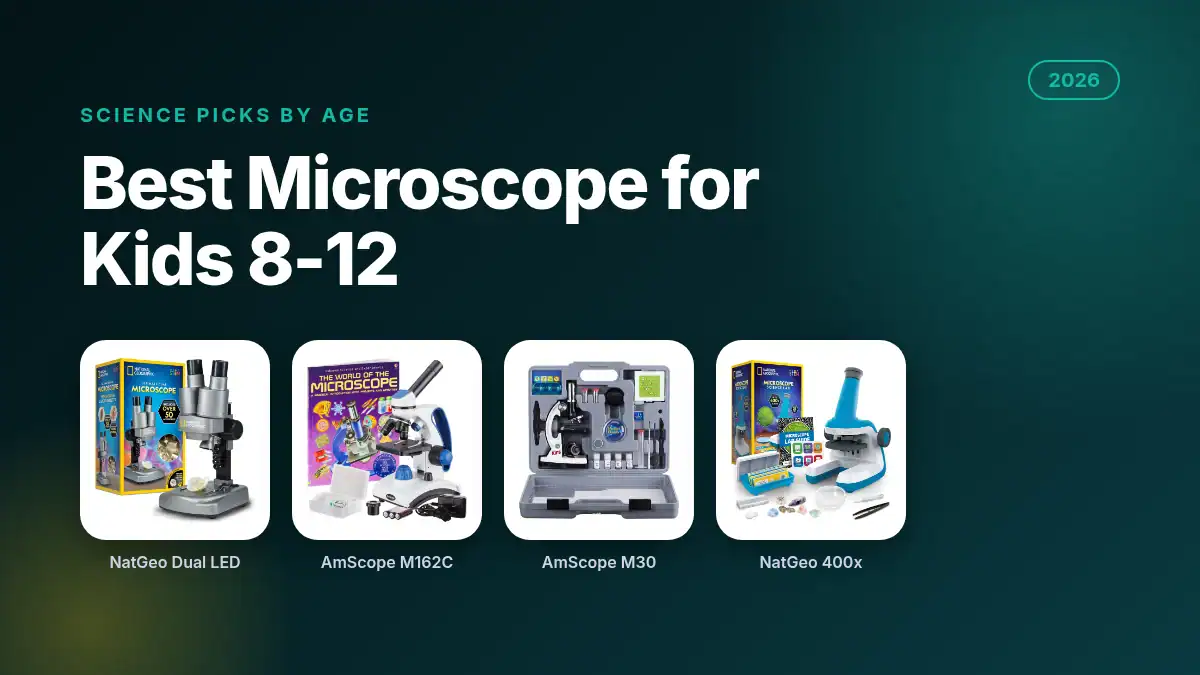
Best Microscope for Kids 8-12: Science Picks (2026)
The best microscope for kids 8-12 lets a curious child look at real slides, bugs, leaves and rocks without fighting blurry images or fiddly controls. Parents shopping for a Christmas science gift usually want a scope that is easy enough for an 8-year-old, powerful enough to keep a 12-year-old interested, and backed by plenty of real buyer reviews. This guide picks five in-stock options by age, use and budget.
Quick answer: The National Geographic Dual LED Microscope Science Kit for Kids Ages 8-12 is the best microscope for kids 8-12 for most families. It works as two microscopes in one (slides from below, 3D objects from above), ships with 50+ accessories, was $89.99 and In Stock from Amazon, and carries a 4.6 out of 5 rating from 3,332 buyers (Nov 7, 2026).
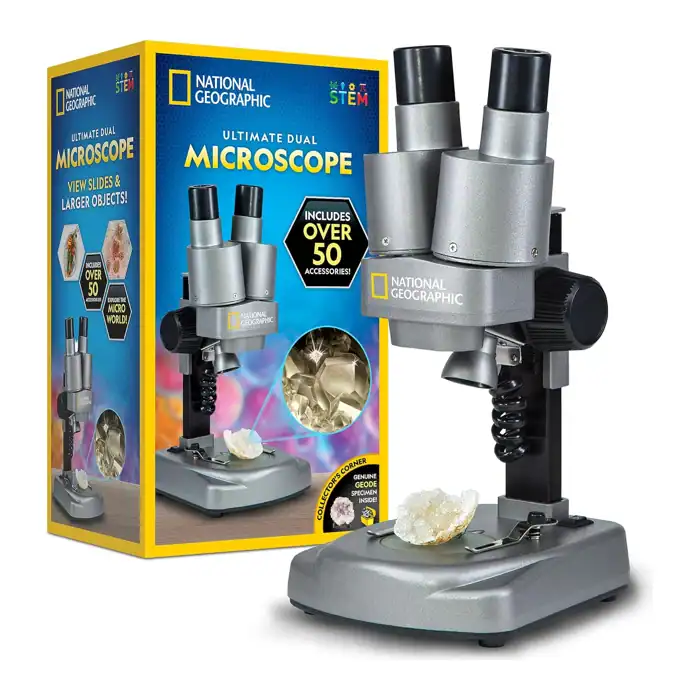
National Geographic Dual LED Microscope Science Kit
Two microscopes in one for ages 8-12: lower LED lights for slides and upper lights for 3D objects like rocks and bugs. Includes 50+ accessories with 10 prepared slides. Rated 4.6 out of 5 by 3,332 Amazon buyers.
| Best For | Ages 8-12 practical science exploration |
| Price | $89.99 (Nov 7, 2026) |
| Discount | In Stock, shipped and sold by Amazon |
| Promotion | 50+ accessories, 10 prepared slides, mini geode |
What is the best microscope for kids 8-12 in 2026?
The best microscope for kids 8-12 in 2026 is the National Geographic Dual LED kit for practical exploring, the AmScope M162C for a real all-metal lab scope, the AmScope M30 for budget cell viewing, the National Geographic 400x for younger kids, and a handheld digital microscope for outdoor nature hunts.
| Microscope | Type | Magnification (listed) | Best for | Price (Nov 7, 2026) | Amazon rating | Our score |
|---|---|---|---|---|---|---|
| National Geographic Dual LED (best overall) | Dual light, slides + 3D objects | 20x and 50x | Ages 8-12 science exploration | $89.99 | 4.6 (3,332 ratings) | 4.7 / 5 |
| AmScope M162C-2L-PB10-WM (best upgrade) | All-metal compound | 40x to 1000x | Ages 11-12 and serious young scientists | $142.99 | 4.6 (591 ratings) | 4.6 / 5 |
| AmScope M30-ABS-KT2-W (best value) | Beginner compound kit | 120x to 1200x | Seeing cells on a budget | $44.99 | 4.4 (29,079 ratings) | 4.5 / 5 |
| National Geographic 400x (best under $40) | Starter compound | Up to 400x | Ages 8-9 first slides | $39.99 | 4.5 (2,851 ratings) | 4.4 / 5 |
| Kids Digital Microscope 200x-1000x (best handheld) | Handheld digital with screen | 200x to 1000x (digital) | Outdoor bugs, plants and photos | $38.49 | 4.5 (2,392 ratings) | 4.2 / 5 |
What magnification does a kids microscope need?
A kids microscope needs about 40x to 400x for most school-age projects. Low power (20x to 50x) shows bugs, crystals and leaves in 3D, while 100x to 400x shows onion skin and cheek cells on slides. Numbers above 400x on cheap scopes often look dim or blurry, so treat 1000x+ claims cautiously.
That is why our top pick pairs a low-power dual-light scope with an honest note: it is the most fun way for an 8-year-old to explore, but a child who wants to see single cells clearly should also have a 400x compound scope or step up to the AmScope picks below.
| Age and goal | Microscope type | Magnification to look for | Setup tip | Next step |
|---|---|---|---|---|
| Ages 8-9, curious about everything | Dual-light or starter compound | 20x to 400x | Start with prepared slides, then 3D objects | Make blank slides from leaves and salt |
| Ages 9-11, school science projects | Beginner compound kit | 40x to 400x (higher is a bonus) | Focus on the lowest power first, then switch up | Stain onion skin with the kit dyes |
| Ages 11-12, wants to see cells clearly | All-metal compound with mechanical stage | 40x to 1000x | Ask an adult to help with the 100x lens | Add a microscope camera later |
| Any age, loves bugs and outdoors | Handheld digital with screen | 200x to 1000x (digital zoom) | Charge fully, use on a flat surface | Save photos for a nature journal |
Which microscope for kids 8-12 should you buy?
Buy the National Geographic Dual LED for most 8 to 12 year olds, the AmScope M162C for an older child who wants a real lab scope, the AmScope M30 for cell viewing under $50, the National Geographic 400x for a younger first scope, and the handheld digital microscope for outdoor exploring.
1. National Geographic Dual LED Microscope (Best Overall)
The National Geographic Dual LED kit is the easiest way to get an 8 to 12 year old exploring right away. Bullets describe two microscopes in one: lower LED lights for biological slides and upper lights for 3D objects such as rocks, coins, feathers and insects. The kit includes over 50 accessories, including 10 prepared slides, blank slides and covers, tweezers, an eye-dropper and a mini geode. Optical glass lenses give 20x and 50x magnification. It was $89.99, In Stock and shipped and sold by Amazon.
Good to know: 20x and 50x is perfect for exploring, but it will not show single cells in fine detail. If your child is studying cells for school, pair it with a 400x scope or choose one of the AmScope picks.
- Price: $89.99 (Nov 7, 2026), In Stock, shipped and sold by Amazon
- Amazon rating: 4.6 out of 5 (3,332 ratings)
- Best for: ages 8-12 practical science exploration
2. AmScope M162C-2L-PB10-WM (Best Upgrade)
The AmScope M162C is the pick for an 11 or 12 year old who is ready for a real lab-style microscope. Bullets describe an all-metal frame, 40x to 1000x across six settings, LED illumination, a dual-layer mechanical stage with coaxial X-Y controls for moving slides smoothly, and a kit with prepared and blank slides, tools and a carrying case. It was $142.99 and In Stock, sold and shipped by AmScope.
Good to know: this is a real compound microscope, so the 1000x setting takes patience and careful focusing. Younger kids may need an adult the first few sessions.
- Price: $142.99 (Nov 7, 2026), In Stock, sold by AmScope
- Amazon rating: 4.6 out of 5 (591 ratings)
- Best for: older kids who want to see cells clearly
3. AmScope M30-ABS-KT2-W Beginner Kit (Best Value)
The AmScope M30 kit has one of the largest review samples of any kids microscope on Amazon. Bullets describe a 52-piece STEM kit, six magnification settings from 120x to 1200x, a monocular head with LED lighting, a rotating color filter wheel, sample slides and a hard ABS case. It was $44.99 and In Stock, sold by Pattern Professional.
Good to know: this is a plastic beginner scope. Start at 120x for the sharpest view, and expect the top settings to look softer than on the all-metal M162C.
- Price: $44.99 (Nov 7, 2026), In Stock, sold by Pattern Professional
- Amazon rating: 4.4 out of 5 (29,079 ratings)
- Best for: budget cell viewing for ages 9-12
4. National Geographic Microscope up to 400x (Best Under $40)
The National Geographic 400x microscope is a friendly first compound scope for 8 and 9 year olds. Bullets call out large focus knobs, a soft-touch eyepiece, an adjustable platform, three magnification levels and lights above and below. The kit includes 6 prepared plant slides, 6 rocks and minerals, 6 blank slides, a pipette, specimen dish, tweezers and a lab guide with merit badge stickers. It was $39.99 and In Stock from Amazon.
Good to know: 400x is the ceiling, which is fine for school-age projects. Kids who outgrow it can step up to the AmScope M162C later.
- Price: $39.99 (Nov 7, 2026), In Stock, shipped and sold by Amazon
- Amazon rating: 4.5 out of 5 (2,851 ratings)
- Best for: younger kids starting with slides
5. Kids Digital Microscope 200x-1000x (Best Handheld)
This handheld digital microscope is the pick for kids who would rather explore the backyard than sit at a desk. Bullets describe a 32GB card for photos and video, a fitted EVA carrying case, 5 real glass prepared slides, a widened 3mm slide slot, five magnification levels from 200x to 1000x, and an easy focus wheel with LED lighting. It was $38.49 and In Stock, sold by BEBANG INC.
Good to know: handheld magnification numbers are digital zoom, so images will not match a compound scope at the same number. It shines for bugs, leaves, fabric and coins, and for saving photos.
- Price: $38.49 (Nov 7, 2026), In Stock, sold by BEBANG INC
- Amazon rating: 4.5 out of 5 (2,392 ratings)
- Best for: outdoor exploring and nature photos
Is a digital or compound microscope better for kids?
A compound microscope is better for kids who want to see cells on slides, because real glass lenses give a clearer view at 100x to 400x. A digital handheld microscope is better for outdoor exploring, younger kids and taking photos. Many families start with one and add the other later.
Compound scopes teach real lab skills: placing a slide, starting at low power and focusing up. Handheld digital scopes trade optical quality for convenience and instant photos. If you already own a tablet or learning toys, a digital scope fits the same screen-friendly routine.
What should kids look at first under a microscope?
Kids should start with prepared slides from the kit, then move to easy home samples: onion skin, salt and sugar crystals, a strand of hair, a leaf, a feather and pond water. These show clear shapes at low power and build focusing skills before kids try trickier samples like cheek cells.
Use this first-week checklist to keep the gift exciting after Christmas morning:
- Day 1: look at every prepared slide at the lowest power, then step up one level.
- Day 2: compare table salt and sugar crystals side by side.
- Day 3: peel a thin layer of onion skin, add a drop of water and a cover slip.
- Day 4: collect a leaf, feather and flower petal from outside and view them from above.
- Day 5: compare your hair with a parent’s or a pet’s hair.
- Day 6: look at a drop of pond or puddle water and draw what moves.
- Day 7: start a science journal with sketches or digital photos.
Crystal-loving kids can grow their own samples to view; our best crystals for kids guide covers growing kits and gem sets.
Is a microscope a good Christmas gift for kids 8-12?
Yes. A microscope is a strong Christmas gift for kids 8-12 because it turns everyday objects into experiments, supports school science and lasts for years. Pair it with a slide kit or a science book, and choose by age: a dual-light or 400x scope for 8 to 9, a compound kit for 10 to 12.
If your child also loves the night sky, our kids guide to astronomy and telescopes makes a great companion gift idea. For kids who like building and coding, see our best robot kits for kids to learn coding, and browse more ideas in our best gifts for kids roundup.
Our scores out of 5 weigh listed optics and magnification, age fit, kit contents, review depth, stock and price. They are editorial scores based on the listings and public product data, not lab tests. Prices and stock change often, so confirm the live Amazon price before you buy.
Frequently Asked Questions
What is the best microscope for kids 8-12?
The National Geographic Dual LED Microscope Science Kit is the best microscope for kids 8-12 for most families at $89.99 with a 4.6 out of 5 rating from 3,332 buyers. Choose the AmScope M162C for older kids who want to see cells clearly.
What magnification is best for a child’s microscope?
About 40x to 400x covers most school-age projects. Low power shows bugs and crystals in 3D, and 400x shows plant and animal cells on slides. Claims above 1000x on cheap or digital scopes usually add zoom, not clarity.
Can kids see cells with a kids microscope?
Yes, with a compound microscope at 100x to 400x. Onion skin and cheek cells are classic first cell samples. The National Geographic Dual LED tops out at 50x, so it is better for 3D objects; pick a 400x or AmScope compound scope for cells.
Is AmScope good for kids?
Yes. The AmScope M30 kit is a popular budget beginner scope with 29,079 Amazon ratings when checked, and the all-metal AmScope M162C suits older kids ready for a real lab-style microscope. Younger kids may need help focusing at high power.
Are handheld digital microscopes worth it for kids?
They are worth it for outdoor exploring, younger kids and taking photos. Their high magnification numbers are digital zoom, so a compound microscope still gives a clearer view of cells on slides.