Best Electronic Learning Toys for 3-Year-Olds (2026): 7 Picks Preschoolers Love
Three is a big year. Your child is suddenly asking “why?” about everything, singing the alphabet song with creative new letters and pressing every button in the house. That curiosity is exactly what a good electronic learning toy can feed, as long as you pick one that matches what a 3-year-old can actually do: listen, press, point, pretend and repeat the same favorite thing fifty times.
The trouble is that most toy aisles lump everything together. A coding robot built for 6-year-olds sits next to a light-up laptop for toddlers, and plenty of “educational” toys are just noisy. We narrowed this list to toys that are made for ages 3 and up (or a range that includes 3), that teach something real (language, letters, numbers, shapes, listening or creativity) and that hold up to preschool hands.
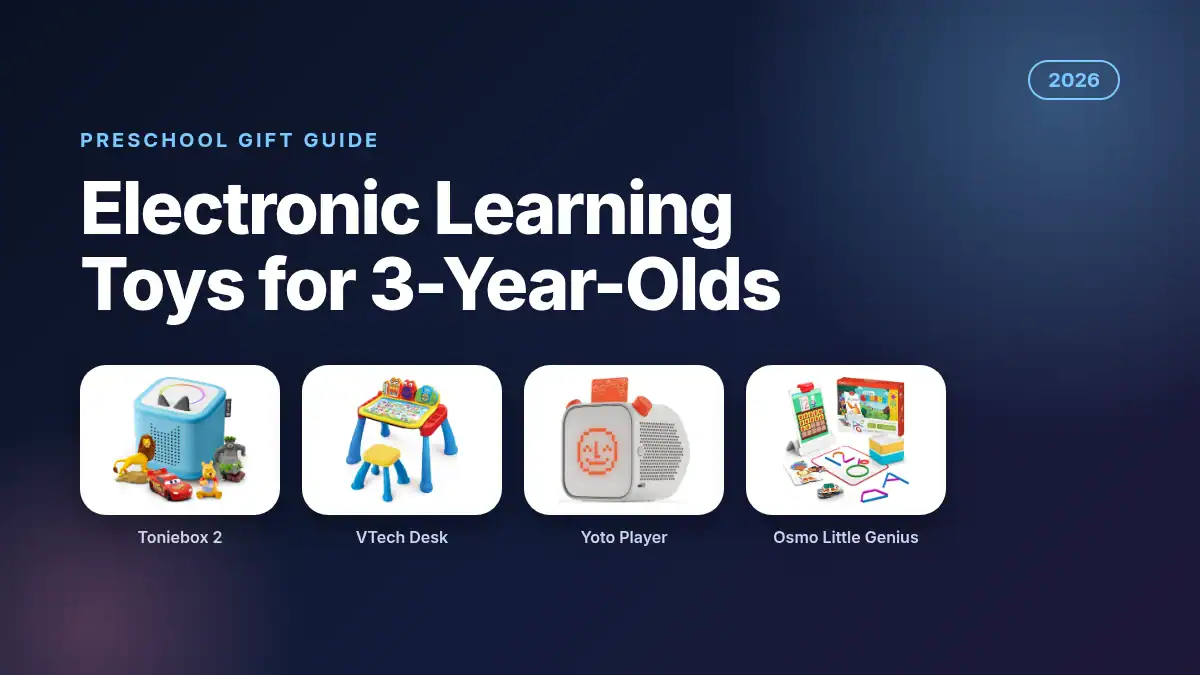
This guide covers the best electronic learning toys for 3-year-olds in 2026, from screen-free audio players to classic learning desks, with prices checked on Amazon US on October 20, 2026. Our top pick is the Toniebox 2, a squishy, screen-free story and song player that a 3-year-old can run completely on their own.
Toniebox 2 Audio Player Disney Bundle (Lightning McQueen, Simba, Winnie the Pooh and Baloo)
The best electronic learning toy for most 3-year-olds: a soft, screen-free audio player that kids control themselves. Place a Tonie figure on top and stories, songs and games start playing, so it builds listening, vocabulary and independence without a screen or ads.
| Best For | Screen-free listening and independent play |
| Price | $189.99 (as of Oct 20 2026) |
| Screen? | No |
| Batteries | Rechargeable |
Best Electronic Learning Toys for 3-Year-Olds at a Glance
| Toy | Best For | Maker Age Range | Screen? | Batteries | Amazon Rating | Price (as of Oct 20 2026) |
|---|---|---|---|---|---|---|
| Toniebox 2 Disney Bundle | Best overall | Toniebox 2 for ages 1 to 9+ (bundle 3+) | No | Rechargeable | 4.7 / 5 (347) | $189.99 |
| VTech Touch and Learn Activity Desk Deluxe | Best learning desk | 2 to 5 years | Small LED display | 4 AA (not included) | 4.7 / 5 (14,690) | $64.99 |
| Yoto Player (3rd Gen) | Grows with them to age 12 | 3 to 12 | Pixel display only | Rechargeable | 4.8 / 5 (950) | $109.99 |
| Osmo Little Genius Starter Kit + Early Math | Best for iPad families | 3 to 5 | Uses your iPad | iPad required | 4.6 / 5 (2,692) | $96.99 |
| LeapFrog LeapStart 3D | Best for pre-reading | 2 to 7 | Small book-reader screen | 2 AA | 4.5 / 5 (7,238) | $63.68 |
| VTech KidiZoom Camera Pix Plus | Best for creative play | 3 to 8 | 1.8 in camera screen | 4 AA (not included) | 4.6 / 5 (2,123) | $49.99 |
| LeapFrog 2-in-1 LeapTop Touch | Best budget pick | 2 to 5 | No | 3 AA (included for demo) | 4.7 / 5 (31,062) | $24.99 |
Prices are a snapshot from Amazon US on October 20, 2026. Toy prices move a lot before Black Friday and the holidays, so check the current deal before you buy.
What Makes a Good Electronic Learning Toy for a 3-Year-Old?
A 3-year-old is not a small 6-year-old. Most kids this age cannot read yet, have short attention spans and learn best through repetition, pretend play and talking with you. The best electronic toys for this age work with that, not against it:
- Kid-controlled, not just kid-entertained: look for toys your child has to press, place, draw or choose with, rather than toys that perform while they watch.
- Audio-led for pre-readers: toys that talk, sing and tell stories hand a non-reader real words and new vocabulary.
- Real early skills: letters, phonics, counting, shapes, colors and listening are the core preschool skills to aim for.
- Screen time you control: a screen-free player or a toy with a tiny display is easier to manage than a full tablet.
- Durability and safety: chunky parts, no tiny pieces for kids who still mouth toys and battery doors with screws.
- Room to grow: expansion packs, new cards or new figures keep a good toy useful into kindergarten.
If your child is still under two, start with our list of the best toys for 1-year-olds instead. For older kids, we also have a broader list of the best electronic learning toys for kids that includes coding robots and STEM kits.
How We Chose These Toys
We did not run a preschool test lab. We compared current Amazon US listings on October 20, 2026, checked that each product was in stock, read the maker’s age ratings and feature lists, and weighed rating volume against what early-childhood educators usually recommend for this age: language, listening, early literacy and numeracy, and independent play. Toys rated mainly for ages 5 and up, and listings that were out of stock today, did not make the cut.
1. Best Overall: Toniebox 2 Audio Player Disney Bundle
The Toniebox 2 is the toy we would put in front of most 3-year-olds first. It is a soft, cube-shaped audio player with no screen. Your child places a small character figure called a Tonie on top and it starts playing that character’s stories and songs. Pressing the ears changes the volume and tapping the sides skips tracks, so even kids who cannot read can run it on their own.
That independence is the learning win. Audio stories and songs build listening skills, vocabulary and attention span, and Tonies says the box is designed for ages 1 to 9 and up, with hundreds of figures to add over time. The second-generation box adds a sleep timer with light and a sunrise alarm for bedtime and wake-up routines, plus Tonieplay interactive games, quizzes and challenges (the Tonieplay controller is sold separately). Parents can manage the box from the tonies app, and there are no screens or ads.
This Disney bundle comes with Lightning McQueen, Simba, Winnie the Pooh and Baloo Tonies, so there is plenty to listen to on day one. As of October 20, 2026 it is $189.99 on Amazon, sold by Tonies US and shipped by Amazon, with a 4.7 out of 5 rating from 347 ratings.
Who it’s for: families who want a screen-free toy for car rides, quiet time and bedtime that a 3-year-old can use alone.
Pros
- No screen, no ads, and kid-friendly controls
- Builds listening, vocabulary and independence
- Sleep timer with light and sunrise alarm
- Huge library of Tonies and Tonieplay games to grow into
Cons
- The priciest pick here, and extra Tonies add up over time
- Tonieplay controller is sold separately
- Needs Wi-Fi to set up and to download new figures
2. Best Learning Desk: VTech Touch and Learn Activity Desk Deluxe
If you picture a classic preschool learning toy, it probably looks a lot like the VTech Touch and Learn Activity Desk Deluxe. It is a sturdy kid-size desk with a stool, and the work surface holds five interactive activity pages that your child presses to hear letters, words, numbers and music. VTech lists 100+ vocabulary words, 20+ activities and 20+ songs and melodies.
The details are what make it great for 3-year-olds. A small LED display shows letter and number stroke order and how to draw basic shapes, which is a nice bridge to early writing. The desk flips into an easel and chalkboard with storage for art supplies, there is a pretend phone and music player, and a progress button reports how your child is doing across activities. When the five included pages get old, VTech sells expansion packs (sold separately) for preschool and pre-K.
As of October 20, 2026 it is $64.99 on Amazon, sold and shipped by Amazon, with a 4.7 out of 5 rating from more than 14,000 ratings. VTech rates it for ages 2 to 5.
Who it’s for: 3-year-olds who love to “do school,” and parents who want one toy that covers letters, numbers and drawing.
Pros
- Five activity pages, 100+ words and 20+ songs
- LED display teaches letter and number stroke order
- Converts to an easel and chalkboard, stool included
- Expansion packs keep it fresh into pre-K
Cons
- Takes up real floor space
- Needs 4 AA batteries, not included
- Electronic sounds can get repetitive for adults
3. Best to Grow With: Yoto Player (3rd Gen)
The Yoto Player is the Toniebox’s biggest rival, and the choice between them comes down to age. Instead of figures, Yoto uses cards: your child pops an audiobook, music or activity card into the slot and it plays, then pulls it out to stop. Big dials control volume and tracks, and a pixel display shows simple icons rather than video.
Yoto is rated for ages 3 to 12, and the card library leans older than Tonies, with 1,000+ cards including bestselling novels, music and activities, plus free podcasts, radio and sleep sounds. It doubles as a nightlight, OK-to-wake alarm clock and room thermometer, plays for up to 16 hours per charge and stores 600+ hours of offline audio. Yoto says it has no cameras, no mics and no ads. A Make Your Own card lets you record your own stories or songs.
As of October 20, 2026 it is $109.99 on Amazon, sold by Yoto Inc and shipped by Amazon, with a 4.8 out of 5 rating from 950 ratings.
Who it’s for: families who want a screen-free audio player that a 3-year-old can start with and still use at 8 or 10.
Pros
- Rated for ages 3 to 12, so it lasts for years
- Huge card library plus free podcasts and radio
- Nightlight, OK-to-wake clock and sleep sounds built in
- Up to 16 hours of playback per charge
Cons
- Cards are easier to lose or bend than chunky figures
- Most story and music cards are bought separately
- A little less toddler-proof than the soft Toniebox
Want more screen-free audio options? See our roundup of the best MP3 players for kids.
4. Best for iPad Families: Osmo Little Genius Starter Kit + Early Math Adventure
If your family already owns an iPad, the Osmo Little Genius Starter Kit turns it into something much more active than tapping glass. A base and reflector let the iPad camera “see” what your child does on the table, so the games respond to real pieces: silicone sticks and rings for forming letters, numbers and shapes, and costume pieces for pretend play.
This version includes six games for ages 3 to 5: Shape Builder, Counting Town, ABCs, Costume Party, Stories and Squiggle Magic. Together they cover letter formation, phonics, counting, numbers and shapes, plus fine-motor skills and imagination. Osmo says no Wi-Fi is needed during play, and the kit works with most iPads running iOS 15 or later.
As of October 20, 2026 it is $96.99 on Amazon, sold by PlayOsmo and shipped by Amazon, with a 4.6 out of 5 rating from 2,692 ratings. If you use an Amazon Fire tablet instead, there is a Little Genius Kit for Fire tablets for about $45.
Who it’s for: iPad households that want screen time to involve real pieces, drawing and building.
Pros
- Physical pieces make screen time more active
- Six games covering phonics, letters, counting and shapes
- Designed specifically for ages 3 to 5
Cons
- The iPad is not included, so it is only a deal if you already own one
- Still screen time, so you will want to set limits
- The listing notes Osmo is under new ownership as of 2026, so keep an eye on long-term app updates
5. Best for Pre-Reading: LeapFrog LeapStart 3D Interactive Learning System
The LeapFrog LeapStart 3D is a book-based learning system. Your child places an activity book in the reader and taps pictures and words with a stylus, and a small screen plays 3D-style animations that reinforce the lesson. LeapFrog says the library covers 700+ activities across more than 25 books (sold separately), with two levels on most activities and skills from preschool through first grade.
For a 3-year-old, the big plus is the grow-with-me stylus, which encourages a proper pencil grip before they start writing for real, and the fact that activities talk your child through reading, counting and problem solving. It is rated for ages 2 to 7, so the same system can carry you into the early grades with new books.
As of October 20, 2026 it is $63.68 on Amazon, sold and shipped by Amazon, with a 4.5 out of 5 rating from 7,238 ratings.
Who it’s for: 3-year-olds who love books and parents who want a structured path toward reading.
Pros
- Talking books build pre-reading and counting skills
- Stylus encourages proper writing grip
- Grows from preschool through first grade with new books
Cons
- Extra books are sold separately and add to the cost
- You need a computer with internet to download books to the system
- Not compatible with older LeapReader books
6. Best for Creative Play: VTech KidiZoom Camera Pix Plus
Not every learning toy needs letters on it. The VTech KidiZoom Camera Pix Plus is a kid-proof digital camera that turns your 3-year-old’s urge to point at everything into a creative project. It has a 2.0 megapixel camera with 4X zoom, a 1.8 inch screen and four built-in games.
The fun extras make it a learning toy. Kids can create a Talking Photo with their own voice and voice effects, add 40+ effects like frames, stamps and kaleidoscope views, stitch 2 to 5 images into a panorama and even build simple animations from up to 100 photos. That is storytelling, sequencing and vocabulary practice disguised as play. A microSD slot expands memory up to 32GB (card not included).
As of October 20, 2026 it is $49.99 on Amazon, sold and shipped by Amazon, with a 4.6 out of 5 rating from 2,123 ratings. VTech rates it for ages 3 to 8, and it comes in blue and pink.
Who it’s for: curious kids who want to copy what grown-ups do with their phones, without handing them your phone.
Pros
- Real photos and videos with kid-friendly effects
- Talking Photo and panorama features spark storytelling
- Rated for ages 3 to 8, so it lasts for years
Cons
- Needs 4 AA batteries, not included
- Photo quality is basic compared with a phone
- microSD card and USB cable are not included
7. Best Budget Pick: LeapFrog 2-in-1 LeapTop Touch
If you want something simple under $30, the LeapFrog 2-in-1 LeapTop Touch is one of the best-selling learning toys on Amazon for a reason. It is a pretend laptop with a keyboard of letters A to Z and numbers 1 to 10, and the screen swivels to turn it into a touch tablet.
There are five learning modes: ABCs, numbers, games, music and messages. Kids can pretend to “email” LeapFrog’s Scout the puppy, and parents can customize it so it helps your child spell their own name. It is rated for ages 2 to 5, so it is a great fit for a younger 3-year-old.
As of October 20, 2026 it is $24.99 on Amazon, sold and shipped by Amazon, with a 4.7 out of 5 rating from more than 31,000 ratings.
Who it’s for: families on a budget, younger 3-year-olds and kids who always want to “work on the computer” like you.
Pros
- Very affordable with a huge rating count
- Flips between laptop and tablet mode
- Can be customized to teach your child’s name
Cons
- Simpler than the other picks, so older 3-year-olds may outgrow it fast
- Included batteries are for demo only
- Sounds and songs can get repetitive for adults
Buying Guide: Choosing an Electronic Learning Toy for a 3-Year-Old
Screen-free or screen-based?
At 3, screen-free audio toys like the Toniebox and Yoto are the easiest to fit into a healthy routine, since they feed language without visual overload. Screen-based options like Osmo can still be valuable, especially when the screen reacts to real pieces your child is handling, but plan on setting limits.
Match the toy to your child’s stage
A young 3-year-old who is still pressing everything will get more from the LeapTop Touch or the VTech desk. An older 3-year-old who is close to 4 is ready for Osmo’s letter-building games, LeapStart books and the KidiZoom camera.
Think about the total cost
Some toys keep costing money. Tonies figures, Yoto cards, LeapStart books and VTech expansion packs all add up. That can be a good thing (the toy grows with your child), but budget for a few extras, and remember they make great stocking stuffers.
Batteries and charging
Rechargeable players like the Toniebox and Yoto save money long term. Battery-powered toys like the VTech desk, LeapStart and KidiZoom are worth pairing with a set of rechargeable AA batteries.
Play together
Even the best toy works better with you nearby. Ask questions about the story they heard, count the shapes together and look through their camera photos. That conversation is where a lot of the real learning happens.
FAQ
What is the best electronic learning toy for a 3-year-old?
For most families, the Toniebox 2 is the best overall pick because it is screen-free, builds listening and vocabulary, and a 3-year-old can run it alone. If you want a more traditional learning toy, the VTech Touch and Learn Activity Desk Deluxe is the best value.
Are electronic toys good for 3-year-olds?
They can be, when they invite your child to do something (press, place, draw, choose) rather than just watch. Use them alongside books, blocks and pretend play, not instead of them, and keep sessions short.
Is a Toniebox or a Yoto better for a 3-year-old?
The Toniebox is softer, more toddler-proof and uses chunky figures, which makes it a great fit at 3. The Yoto Player uses cards and is rated for ages 3 to 12, so it is the better long-term pick if you want one player that lasts into the grade-school years.
Should a 3-year-old have a tablet?
Most experts recommend keeping screen time limited at this age and choosing high-quality content you watch or play together. Toys like Osmo, which react to real pieces on the table, are a good middle ground. If you are thinking about a full tablet, read our guide to the best tablets for kids first.
How much should I spend on a learning toy for a 3-year-old?
Great options start around $25 (LeapFrog LeapTop Touch). Most of the best picks land between $50 and $110, and premium screen-free players like the Toniebox 2 bundle cost more but come with several figures included.
Conclusion
The best electronic learning toys for 3-year-olds let your child take the lead. The Toniebox 2 is our top pick for screen-free stories, songs and independence, the VTech Touch and Learn Activity Desk Deluxe is the classic all-in-one learning station, and the Yoto Player is the audio player that grows all the way to age 12. For iPad families, Osmo Little Genius makes screen time more active, the LeapStart 3D builds a path toward reading, the KidiZoom Camera Pix Plus sparks creativity, and the LeapTop Touch is the best value under $30.
Pick the one that fits your child’s personality, add a few favorite stories or books, and get ready to hear the same song on repeat. That is how 3-year-olds learn.